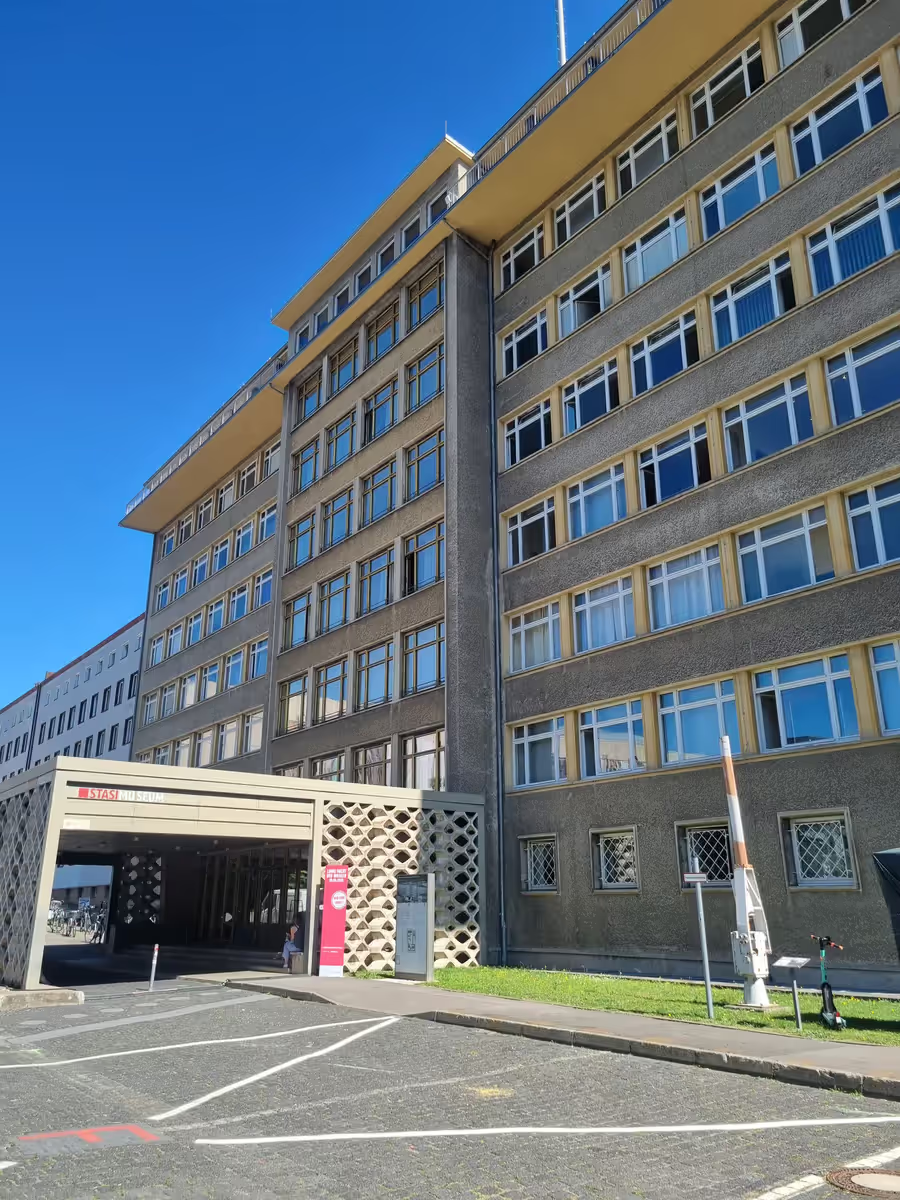
Stasi Headquarters Berlin – The Heart of the GDR Surveillance State
91,000 employees, up to 620,000 informants, 111 kilometres of files: the Stasi was one of the most effective intelligence apparatuses in history. Mielke's office, the wiretapping room, the battle for the files – experienced privately and with historical depth.
Plan Your Private TourDuration
1 day
Region
Berlin-Lichtenberg
Format
Private Chauffeur Tour
Highlights
- Erich Mielke's office – preserved exactly as it was, 32 years at the centre of GDR surveillance
- 91,000 employees, up to 620,000 informants – the numbers behind the system
- 111 km of files and the dramatic occupation on 15 January 1990
- Wiretapping installation – Mielke had even his own ministers' calls recorded
- Permanent exhibition "State Security in the SED Dictatorship"
- Optional combination with Hohenschönhausen and Wandlitz as a multi-day GDR tour
Enquire – no commitment, no form.
Enquire →Experience
Location and the Complex
The former headquarters of the Ministry for State Security (MfS) is located in the Berlin district of Lichtenberg, approximately 6 kilometres east of Alexanderplatz. The complex still encompasses around 50 buildings spread across a site of several hectares. Built from 1950 onwards, this was the nerve centre of East Germany's secret police until 1990 – and until its occupation by civil rights activists on 15 January 1990, completely invisible to the public.
The Stasi: Numbers and System
The Ministry for State Security was one of the most effective intelligence apparatuses in history. At the time of its dissolution in 1990, it employed around 91,000 full-time staff – one Stasi officer for every 63 East German citizens. In addition, an estimated 174,000 to 620,000 unofficial informants (IMs) spied on neighbours, colleagues, friends and family members.
The Stasi archive, now administered by Germany's Federal Archives, comprises approximately 111 kilometres of files – laid end to end, a distance from Berlin to Frankfurt. Add to that millions of photographs, thousands of video reels, and the so-called "Rosenholz" dataset containing the real names of West German informants, which was only returned from CIA holdings after 2000.
What the Stasi Means for Western Visitors
For visitors from Britain or the United States, the Stasi invites comparison with familiar domestic surveillance programmes. The comparison is instructive – but not in the direction most assume. The FBI's COINTELPRO programme (1956–1971) monitored civil rights leaders, anti-war activists and political dissidents. It was extensive, damaging, and ultimately judged illegal. When exposed, it was treated as a scandal: a departure from democratic norms, an abuse of exceptional powers.
The Stasi was not a departure. It was the norm. Where COINTELPRO was a covert exception to a society governed by rule of law, the Stasi was a comprehensive, openly institutional system of social control that applied to everyone. Not suspects. Citizens. One officer for every 63 East Germans; an estimated one informal informant for every 6.5 citizens. In a workplace of twenty people, statistically, at least one colleague was likely reporting to the Stasi. This was not surveillance of the dangerous. It was surveillance as a permanent condition of existence.
George Orwell published Nineteen Eighty-Four in 1949 – the same year the GDR was founded. When the Stasi archives opened in 1990, historians found that Orwell's surveillance state had, in several respects, been exceeded in practice. The telescreen was real; it was a network of informants, not a single screen. The German film The Lives of Others (Das Leben der Anderen, 2006 Academy Award for Best Foreign Language Film) depicts Stasi surveillance of a playwright in 1984 East Berlin. The film's power is not in spectacular evil but in the grey routinisation of total control. Walking through Building 1 at Normannenstrasse, you understand why the screenplay was written the way it was.
Erich Mielke's Office and Building 1
The centrepiece of the site is Building 1 (Haus 1) – the main building where Minister Erich Mielke presided from 1957 to 1989. Mielke's office has been preserved exactly as it was: the dark green desk, the red leather chairs, the direct telephone line to Moscow, the display case of medals and decorations. Mielke ruled the apparatus that kept the East German population in fear for 32 years – and was himself a profoundly mistrustful man who barely trusted his closest colleagues.
The upper floors also contain the eavesdropping installation through which Mielke had the telephone calls of his own ministers recorded. The system of suspicion knew no exceptions – not even the leadership itself was safe from it.
15 January 1990: The Occupation and the Battle to Save the Files
On 15 January 1990, two months after the fall of the Berlin Wall, thousands of Berliners occupied the Stasi headquarters in Lichtenberg – preventing the systematic destruction of files that was already well underway. Staff had been shredding and tearing up millions of pages in the preceding weeks. The civil rights activists secured what could still be secured. The shredded files are still being reconstructed today with puzzle machines and AI technology – a project likely to continue for decades.
Today: Memorial Site and Research
The Stasi Headquarters Memorial has been open to visitors since 1995. Building 1 can be toured with a guide; the permanent exhibition "State Security in the SED Dictatorship" explains the structure, methods and impact of the surveillance apparatus. The memorial is also the starting point for accessing personal Stasi files: those affected can submit a request to the Federal Archives – an offer still used by thousands of people every year, decades after the GDR's end.
Related Tours
Frequently Asked Questions
What can you see at the former Stasi headquarters?
How long does the visit take?
Do I need to arrange my own transport?
Can it be combined with other GDR sites?
Your Experience
- Private transfer in a luxury vehicle
- Personal driver & travel companion
- Handpicked luxury hotels
- Flexible itinerary adjustments
Why this tour?
The Stasi headquarters is not a museum that displays history – it is itself history. The buildings, offices, filing cabinets and surveillance installations are not reconstructed, but original. Walking through Mielke's office means standing in a room from which East German society was controlled for 40 years.
Your Individual Private Tour
Every trip is planned for you
Route, duration, hotels and itinerary – tailored to your wishes. Price on request.
Enquire Now